What Intensity I1 Corresponds to 20.0 Db ?
Learning Objectives
By the terminate of this department, you will exist able to:
- Ascertain intensity, sound intensity, and sound pressure.
- Calculate sound intensity levels in decibels (dB).
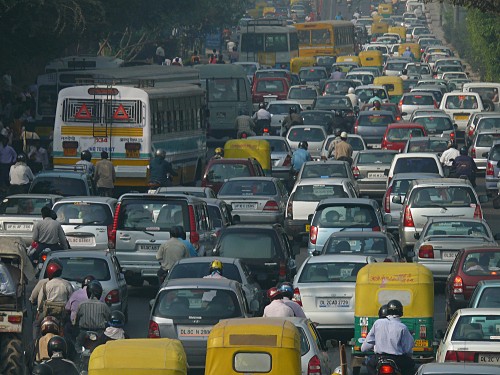
Figure 1. Noise on crowded roadways like this one in Delhi makes it difficult to hear others unless they shout. (credit: Lingaraj G J, Flickr)
In a tranquillity wood, y'all can sometimes hear a single leaf fall to the basis. After settling into bed, y'all may hear your claret pulsing through your ears. Just when a passing motorist has his stereo turned up, you cannot fifty-fifty hear what the person next to you in your car is saying. We are all very familiar with the loudness of sounds and enlightened that they are related to how energetically the source is vibrating. In cartoons depicting a screaming person (or an animal making a loud noise), the cartoonist often shows an open oral fissure with a vibrating uvula, the hanging tissue at the back of the mouth, to suggest a loud audio coming from the throat Effigy 2. High noise exposure is hazardous to hearing, and information technology is common for musicians to have hearing losses that are sufficiently severe that they interfere with the musicians' abilities to perform. The relevant physical quantity is sound intensity, a concept that is valid for all sounds whether or non they are in the audible range.
Intensity is defined to be the power per unit area carried by a wave. Power is the rate at which energy is transferred by the wave. In equation form, intensity I is [latex]I=\frac{P}{A}\\[/latex], where P is the power through an area A. The SI unit of measurement for I is Westward/m2. The intensity of a sound moving ridge is related to its aamplitude squared by the following human relationship:
[latex]\displaystyle{I}=\frac{\left(\Delta{p}\right)^2}{2\rho{v}_{\text{west}}}\\[/latex].
Here Δp is the force per unit area variation or pressure level amplitude (half the divergence betwixt the maximum and minimum pressure in the audio wave) in units of pascals (Pa) or Due north/one thousand2. (We are using a lower case p for pressure to distinguish information technology from power, denoted by P above.) The free energy (as kinetic energy [latex]\frac{mv^2}{2}\\[/latex]) of an oscillating element of air due to a traveling sound wave is proportional to its amplitude squared. In this equation, ρ is the density of the material in which the sound wave travels, in units of kg/m3, and 5 w is the speed of sound in the medium, in units of m/s. The pressure level variation is proportional to the amplitude of the oscillation, then I varies equally (Δp)ii (Figure 2). This relationship is consistent with the fact that the audio wave is produced by some vibration; the greater its pressure level amplitude, the more the air is compressed in the sound it creates.
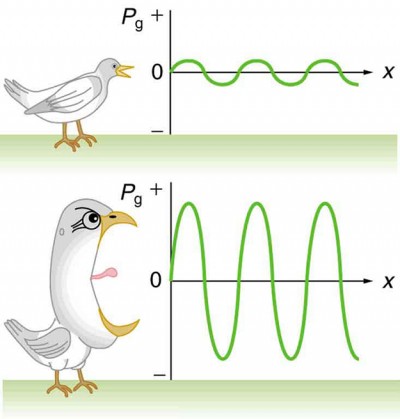
Figure two. Graphs of the gauge pressures in ii sound waves of different intensities. The more intense sound is produced past a source that has larger-amplitude oscillations and has greater pressure maxima and minima. Because pressures are college in the greater-intensity sound, it can exert larger forces on the objects information technology encounters.
Sound intensity levels are quoted in decibels (dB) much more than often than sound intensities in watts per meter squared. Decibels are the unit of option in the scientific literature likewise as in the popular media. The reasons for this choice of units are related to how we perceive sounds. How our ears perceive sound can be more accurately described by the logarithm of the intensity rather than directly to the intensity. The sound intensity level β in decibels of a audio having an intensity I in watts per meter squared is defined to be [latex]\beta\left(\text{dB}\right)=x\log_{10}\left(\frac{I}{I_0}\correct)\\[/latex], where I 0 = 10−12 Westward/g2 is a reference intensity. In particular, I 0 is the lowest or threshold intensity of audio a person with normal hearing can perceive at a frequency of 1000 Hz. Sound intensity level is non the aforementioned as intensity. Because β is defined in terms of a ratio, it is a unitless quantity telling you the level of the audio relative to a stock-still standard (10−12 Westward/m2, in this instance). The units of decibels (dB) are used to betoken this ratio is multiplied by x in its definition. The bel, upon which the decibel is based, is named for Alexander Graham Bell, the inventor of the phone.
| Table 1. Sound Intensity Levels and Intensities | ||
|---|---|---|
| Sound intensity level β (dB) | Intensity I(Due west/m2) | Instance/consequence |
| 0 | 1 × x–12 | Threshold of hearing at 1000 Hz |
| 10 | one × x–eleven | Rustle of leaves |
| twenty | 1 × 10⁻¹⁰ | Whisper at 1 g distance |
| thirty | 1 × ten–9 | Tranquillity home |
| 40 | i × 10–8 | Average domicile |
| fifty | 1 × 10⁻⁷ | Boilerplate part, soft music |
| 60 | 1 × 10–half dozen | Normal conversation |
| 70 | 1 × x–5 | Noisy role, decorated traffic |
| lxxx | 1 × 10⁻⁴ | Loud radio, classroom lecture |
| 90 | 1 × 10–three | Within a heavy truck; damage from prolonged exposure[1] |
| 100 | 1 × 10⁻² | Noisy manufactory, siren at 30 k; damage from 8 h per 24-hour interval exposure |
| 110 | i × x–1 | Damage from 30 min per day exposure |
| 120 | 1 | Loud stone concert, pneumatic chipper at 2 thou; threshold of pain |
| 140 | 1 × 10ii | Jet plane at 30 k; severe pain, damage in seconds |
| 160 | 1 × 10four | Bursting of eardrums |
The decibel level of a sound having the threshold intensity of 10−12 W/thousand2 is β = 0 dB, because log101 = 0. That is, the threshold of hearing is 0 decibels. Table 1 gives levels in decibels and intensities in watts per meter squared for some familiar sounds.
One of the more striking things nearly the intensities in Table 1 is that the intensity in watts per meter squared is quite small for nigh sounds. The ear is sensitive to equally little as a trillionth of a watt per meter squared—fifty-fifty more impressive when you realize that the area of the eardrum is but about 1 cm2, so that simply 10–16 W falls on it at the threshold of hearing! Air molecules in a audio wave of this intensity vibrate over a distance of less than one molecular diameter, and the approximate pressures involved are less than 10–9 atm.
Another impressive feature of the sounds in Table 1 is their numerical range. Sound intensity varies by a gene of 1012 from threshold to a sound that causes harm in seconds. You lot are unaware of this tremendous range in audio intensity considering how your ears respond tin be described approximately equally the logarithm of intensity. Thus, audio intensity levels in decibels fit your experience better than intensities in watts per meter squared. The decibel calibration is too easier to relate to because most people are more accepted to dealing with numbers such as 0, 53, or 120 than numbers such as 1.00 × ten–11.
One more than observation readily verified by examining Table i or using [latex]I=\frac{\left(\Delta{p}\correct)^2}{ii\rho{v}_{\text{w}}}\\[/latex] is that each gene of 10 in intensity corresponds to x dB. For instance, a 90 dB sound compared with a 60 dB sound is thirty dB greater, or three factors of 10 (that is, 103 times) as intense. Another example is that if one sound is 107 as intense as some other, it is 70 dB higher. See Table two.
| Table ii. Ratios of Intensities and Corresponding Differences in Sound Intensity Levels | |
|---|---|
| [latex]\frac{I_2}{I_1}\\[/latex] | β 2 –β ane |
| two.0 | iii.0 dB |
| 5.0 | vii.0 dB |
| 10.0 | 10.0 dB |
Example ane. Calculating Sound Intensity Levels: Sound Waves
Calculate the sound intensity level in decibels for a sound wave traveling in air at 0ºC and having a pressure amplitude of 0.656 Pa.
Strategy
We are given Δp, then we can calculate I using the equation [latex]I=\frac{\left(\Delta{p}\right)^ii}{\left(two\rho{5}_{\text{w}}\right)^2}\\[/latex]. Using I, we can calculate β straight from its definition in [latex]\beta\left(\text{dB}\right)=10\log_{10}\left(\frac{I}{I_0}\right)\\[/latex].
Solution
1. Identify knowns: Audio travels at 331 m/due south in air at 0ºC. Air has a density of 1.29 kg/m3 at atmospheric pressure level and 0ºC.
2. Enter these values and the pressure amplitude into [latex]I=\frac{\left(\Delta{p}\right)^2}{2\rho{v}_{\text{w}}}\\[/latex]:
[latex]I=\frac{\left(\Delta{p}\right)^2}{2\rho{v}_{\text{w}}}=\frac{\left(0.656\text{ Pa}\right)^two}{two\left(1.29\text{ kg/k}^3\correct)\left(331\text{ chiliad/s}\right)}=5.04\times10^{-four}\text{ W/m}^2\\[/latex]
iii. Enter the value for I and the known value for I 0 into [latex]\beta\left(\text{dB}\correct)=10\log_{10}\left(\frac{I}{I_0}\right)\\[/latex]. Calculate to find the audio intensity level in decibels:
10 log10(v.04 × 108) = ten(8.lxx)dB = 87 dB.
Word
This 87 dB sound has an intensity five times as great as an eighty dB audio. And then a factor of v in intensity corresponds to a divergence of 7 dB in sound intensity level. This value is truthful for any intensities differing by a factor of five.
Case 2. Change Intensity Levels of a Sound: What Happens to the Decibel Level?
Bear witness that if one audio is twice as intense as another, it has a audio level nigh 3 dB college.
Strategy
You are given that the ratio of two intensities is 2 to i, and are so asked to discover the departure in their audio levels in decibels. You can solve this problem using of the properties of logarithms.
Solution
1. Place knowns.
The ratio of the two intensities is 2 to ane, or:
[latex]\frac{I_2}{I_1}=2.00\\[/latex].
We wish to show that the divergence in sound levels is almost three dB. That is, we want to prove
β 2 −β i = iii dB.
Note that
[latex]\log_{10}b-\log_{10}a=\log_{x}\left(\frac{b}{a}\correct)\\[/latex].
2. Use the definition of β to become:
[latex]\beta_{ii}-\beta_{one}=ten\log_{10}\left(\frac{I_2}{I_1}\right)=ten\log_{10}2.00=10\left(0.301\correct)\text{ dB}\\[/latex]
Thus,
β ii −β 1 = 3.01 dB.
Word
This means that the two sound intensity levels differ past 3.01 dB, or nigh iii dB, every bit advertised. Note that because only the ratio [latex]\frac{I_2}{I_1}\\[/latex] is given (and non the bodily intensities), this result is true for whatsoever intensities that differ by a factor of ii. For example, a 56.0 dB sound is twice as intense as a 53.0 dB sound, a 97.0 dB sound is half every bit intense as a 100 dB sound, and so on.
It should be noted at this indicate that there is another decibel scale in use, chosen the audio pressure level level, based on the ratio of the pressure amplitude to a reference pressure. This scale is used particularly in applications where audio travels in water. It is beyond the scope of most introductory texts to treat this calibration because it is non commonly used for sounds in air, but it is of import to annotation that very different decibel levels may be encountered when sound pressure levels are quoted. For example, body of water noise pollution produced by ships may be as dandy as 200 dB expressed in the audio pressure level, where the more familiar sound intensity level we use here would exist something under 140 dB for the same sound.
Take-Domicile Investigation: Feeling Audio
Find a CD player and a CD that has rock music. Place the player on a low-cal table, insert the CD into the player, and get-go playing the CD. Place your paw gently on the table next to the speakers. Increment the volume and note the level when the table just begins to vibrate as the rock music plays. Increment the reading on the volume control until information technology doubles. What has happened to the vibrations?
Check Your Agreement
Part ane
Draw how amplitude is related to the loudness of a sound.
Solution
Amplitude is directly proportional to the experience of loudness. Every bit amplitude increases, loudness increases.
Office 2
Identify common sounds at the levels of 10 dB, 50 dB, and 100 dB.
Solution
10 dB: Running fingers through your hair.
50 dB: Inside a tranquility home with no television or radio.
100 dB: Take-off of a jet plane.
Department Summary
- Intensity is the same for a sound moving ridge equally was defined for all waves; it is [latex]I=\frac{P}{A}\\[/latex], where P is the power crossing area A. The SI unit for I is watts per meter squared. The intensity of a audio wave is as well related to the pressure amplitude Δp, [latex]I=\frac{{\left(\Delta p\right)}^{two}}{2{\rho{v}}_{w}}\\[/latex], where ρ is the density of the medium in which the audio wave travels and 5 w is the speed of sound in the medium.
- Sound intensity level in units of decibels (dB) is [latex]\beta \left(\text{dB}\right)=\text{10}\log_{10}\left(\frac{I}{{I}_{0}}\right)\\[/latex], where I0 = x–12 W/mii is the threshold intensity of hearing.
Conceptual Questions
- Vi members of a synchronized swim team wear earplugs to protect themselves against water pressure at depths, but they tin can still hear the music and perform the combinations in the water perfectly. 1 twenty-four hour period, they were asked to get out the puddle so the dive team could practice a few dives, and they tried to exercise on a mat, but seemed to have a lot more than difficulty. Why might this be?
- A community is concerned about a programme to bring train service to their downtown from the town'due south outskirts. The current sound intensity level, even though the rail yard is blocks away, is 70 dB downtown. The mayor assures the public that in that location will be a difference of only 30 dB in sound in the downtown area. Should the townspeople be concerned? Why?
Problems & Exercises
- What is the intensity in watts per meter squared of 85.0-dB audio?
- The warning tag on a backyard mower states that it produces noise at a level of 91.0 dB. What is this in watts per meter squared?
- A sound moving ridge traveling in 20ºC air has a pressure aamplitude of 0.5 Pa. What is the intensity of the wave?
- What intensity level does the sound in the preceding problem stand for to?
- What audio intensity level in dB is produced by earphones that create an intensity of 4.00 × ten−2 W/chiliad2?
- Show that an intensity of 10−12 West/m2 is the same as ten−16 W/m2.
- (a) What is the decibel level of a audio that is twice every bit intense as a xc.0-dB sound? (b) What is the decibel level of a sound that is i-fifth as intense as a 90.0-dB sound?
- (a) What is the intensity of a audio that has a level 7.00 dB lower than a iv.00 × 10−9 W/m2 sound? (b) What is the intensity of a sound that is iii.00 dB college than a four.00 × ten−nine W/m2 sound?
- (a) How much more intense is a audio that has a level 17.0 dB higher than another? (b) If one sound has a level 23.0 dB less than some other, what is the ratio of their intensities?
- People with proficient hearing can perceive sounds as low in level as −eight.00 dB at a frequency of 3000 Hz. What is the intensity of this sound in watts per meter squared?
- If a large housefly three.0 m away from you makes a noise of 40.0 dB, what is the racket level of g flies at that distance, assuming interference has a negligible result?
- Ten cars in a circumvolve at a smash box competition produce a 120-dB audio intensity level at the middle of the circle. What is the average sound intensity level produced at that place by each stereo, assuming interference effects can be neglected?
- The amplitude of a audio wave is measured in terms of its maximum approximate pressure level. By what factor does the amplitude of a audio wave increase if the sound intensity level goes up by 40.0 dB?
- If a sound intensity level of 0 dB at 1000 Hz corresponds to a maximum guess force per unit area (audio amplitude) of 10−ix atm, what is the maximum gauge pressure in a threescore-dB sound? What is the maximum approximate pressure level in a 120-dB sound?
- An 8-hour exposure to a sound intensity level of 90.0 dB may cause hearing damage. What energy in joules falls on a 0.800-cm-diameter eardrum so exposed?
- (a) Ear trumpets were never very common, but they did assist people with hearing losses by gathering sound over a large area and concentrating information technology on the smaller area of the eardrum. What decibel increase does an ear trumpet produce if its sound gathering expanse is 900 cm2 and the surface area of the eardrum is 0.500 cmii, but the trumpet only has an efficiency of 5.00% in transmitting the sound to the eardrum? (b) Comment on the usefulness of the decibel increase found in role (a).
- Audio is more than effectively transmitted into a stethoscope past direct contact than through the air, and it is further intensified by existence concentrated on the smaller area of the eardrum. It is reasonable to presume that audio is transmitted into a stethoscope 100 times as effectively compared with manual though the air. What, then, is the gain in decibels produced by a stethoscope that has a sound gathering surface area of 15.0 cm2, and concentrates the sound onto 2 eardrums with a total expanse of 0.900 cm2 with an efficiency of 40.0%?
- Loudspeakers can produce intense sounds with surprisingly pocket-size energy input in spite of their depression efficiencies. Calculate the power input needed to produce a 90.0-dB sound intensity level for a 12.0-cm-diameter speaker that has an efficiency of one.00%. (This value is the sound intensity level right at the speaker.)
Glossary
intensity: the power per unit area carried by a moving ridge
sound intensity level: a unitless quantity telling you the level of the sound relative to a stock-still standard
audio pressure level: the ratio of the pressure aamplitude to a reference force per unit area
Selected Solutions to Issues & Exercises
1. three.16 × x−4 W/mtwo
3. iii.04 × x−4 West/m2
5. 106 dB
7. (a) 93 dB; (b) 83 dB
9. (a) l.1; (b) v.01 × 10−iii or [latex]\frac{one}{200}\\[/latex]
11. 70.0 dB
13. 100
15. 1.45 × 10⁻³ J
17. 28.2 dB
Source: https://courses.lumenlearning.com/physics/chapter/17-3-sound-intensity-and-sound-level/
0 Response to "What Intensity I1 Corresponds to 20.0 Db ?"
Post a Comment