Riversdale Boyd House ââåarthur and Yvonne Boyd Art Centreã¢ââ
Designed to make a minimal impact on the local eco-organisation, Glenn Murcutt's Education Centre in New S Wales has an intuitive experience for place and nature
Originally published in January 2000, this slice was republished online in April 2017
With ii Sydney colleagues whom he taught as students and who accept both worked with him on several occasions,1 Glenn Murcutt has only completed his first public building since the Kempsey museum.ii Equally with Murcutt's houses, it is wedded to the site. Riversdale is an isolated private manor bounded by the river Shoal haven near Nowra, three hours' drive from Sydney; it was formerly endemic by the creative person Arthur Boyd,3 who went there to imbibe the Australian wilderness- i of his main sources of inspiration.
Three rural buildings stood on this large tract of agricultural state, including the barn Boyd used every bit his studio. Skirted by the bush, open grassland slopes downward to the river. The brief required an open up art-education eye with accommodation for resident artists and 32 young students both from Australia and round the earth.
i
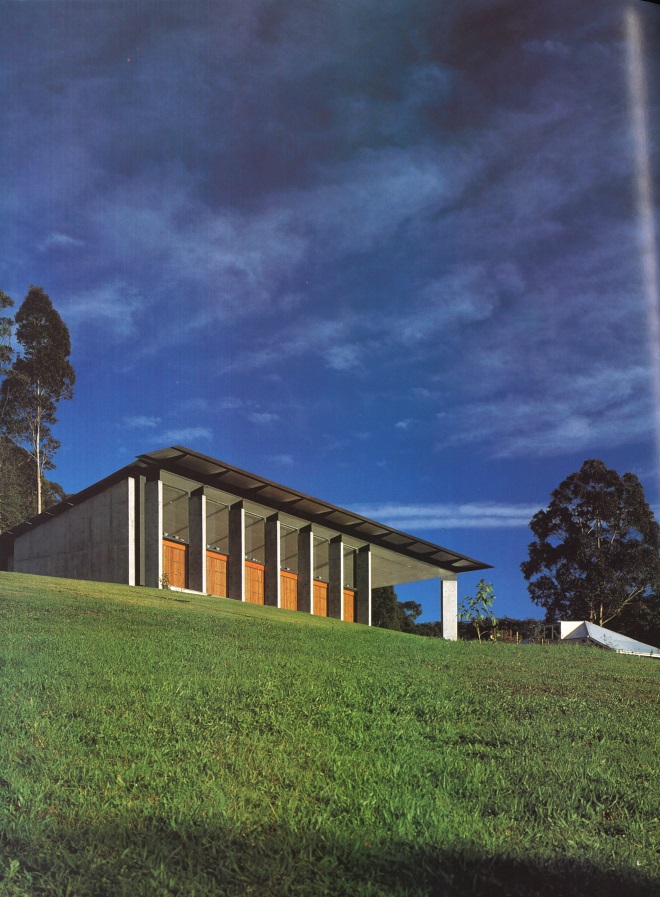
Powerfully rooted in the mural, the building's silent monumentality recalls Nordic Modernism.
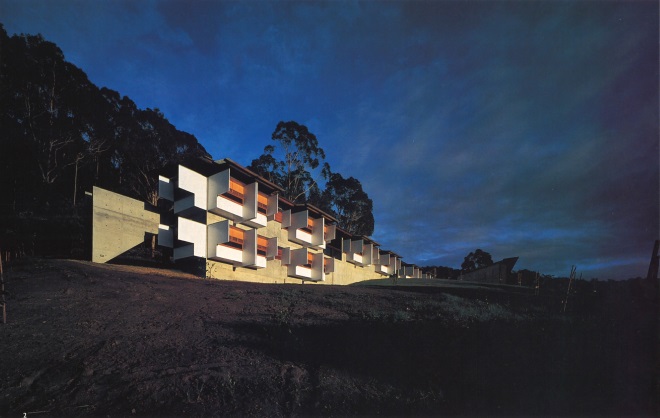
Dormitory accomodation is contained in a long range at the soutern stop of the circuitous.
Picking upwards on the notions of initiation, discovery and experience of the landscape emphasized past the didactics programme, the building is conceived in terms of an itinerary revealing the place fleck by bit. Playing on the natural features of the site, the arrival sequence from the only admission signal is laid out as an oblique, linear, uphill approach route, to delay the moment the centre commencement comes into view. The two chief functions- communal activities and dormitories- have singled-out forms: refectory and veranda are grouped below the roof of the lofty peachy hall, with north and east elevations giving onto the view, while bedrooms and washing facilities are aligned in a long, thin range originating backside the hall, to which it is linked by the kitchen.
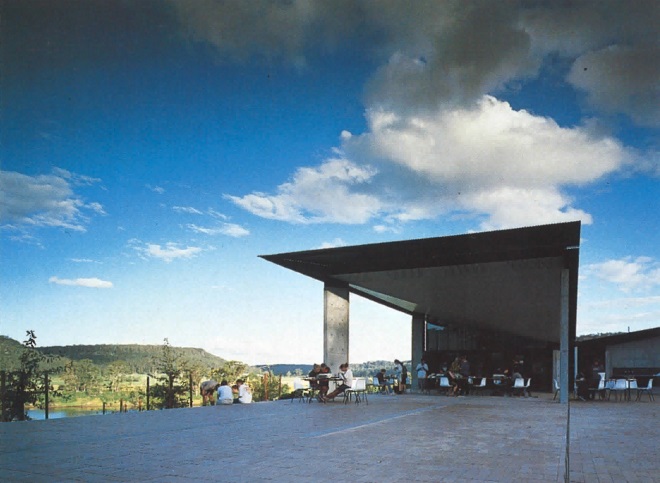
The circuitous dominates the valley from a flattened expanse above the alluvion level, at the intersection between the cultivated and the natural landscape. lt is separated from the existing buildings by a terrace where the future 350- seat amphitheatre is to be sited, giving axial views of the river. A transition between the scale of the mural and that of the living quarters is provided by the white soffit of the inverted roof gradient, which signals the gap leading to the bedrooms at the rear. The itinerary continues south along this passageway, terminating in a spectacular flight of steps with concrete flank walls which momentarily cut off the view and compress the visitors before immersing them in the landscape 3m below.

vi
Conversely, the dormitory range highlights topographical variations: at the southern end, it dramatizes the drop in ground level and draws attention to the slope. Verandas slotted between residue-units act as open-air studios -vantage points where people tin encounter and work in osmosis with the panorama. Windows, bays and the cracking hall capture the dissimilar scales of the well-nigh and distant mural.
'By skillful framing of views, the edifice provides an musical instrument for reading the landscape'
Separated in programme, the residential units are united by a shared roof; the continuity of the range is punctuated at regular intervals past verandas, recessed bathrooms and the shaft of light upon which the roof floats. Consistent dissociation of the various elements- building from roof, living quarters from circulation, open from enclosed areas- gives a measure of transparency through the edifice linking the grassland landscape to that of the bush-league.
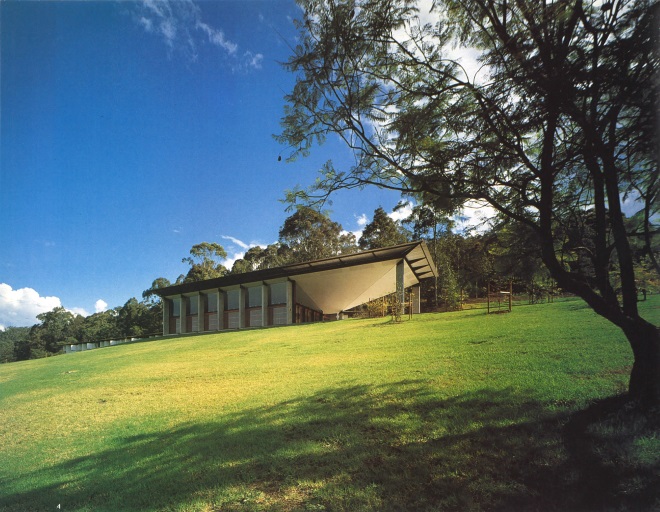
Exploting the natural features of the site, the building is conceived as a revelatory voyage of discovery.
To establish this dialogue between scales, the architects have modelled the interstices as much as they have the volumes, by exploring relationships between the unity of the building and the aperture of its parts. And they have sought to make the building limits dematerialize progressively at the interface with the natural environment: the finely honed roof structures, the sun billow fins projecting from the walls of the dormitory range, the hovering thin metal roofcovering. Elements of this peripheral guild ascertain a transitional layer betwixt the interior and the outside- a virtual threshold between nature and intimacy.
The building is contained at each end by two major events: the sculptural triangular concrete staircase and, to a higher place all, the archway canopy to the bully hall, the silent monumentality of which is reminiscent of Asplund and Lewerentz's chapel at the Woodland Cemetery or, indeed, Utzon's canopy for the Kuwait parliament building. Murcutt and Lewin freely acknowledge their Scandinavian references and their deep affinity for a Nordic Modernism, combining functional rigour, plastic expression, the cult of nature and a taste for materials and detail with the total experience of place.
Untitled 1
Their concern to express orders of construction is reflected in the choice and distribution of materials. Concrete, which none of them had used before, was required to achieve fire separation between the bedrooms. Bandage in situ and left exposed, it contributes the richness of texture, the brilliance of surface and the unity of mass sought to create a physical presence in this immense site. Yet the building is designed to brand as piffling impact as possible on the local eco-system. Pile foundations allow the ground to bleed naturally, all sewage and rubbish is treated on site and the effluent channelled away from the centre through an irrigation organization.
Rainwater is collected and stored in a concrete reservoir in the basement and, where appropriate, recycled timber has been used- the structural members are of recycled native Australian hardwoods, for instance. The building has neither heating nor airconditioning. As with most of Murcutt'southward projects, the location and orientation of glazing, sunbreakers and canopies, combined with natural ventilation achieved past overdoor openings and slatted wall planes, are designed to allow the building to breathe and to create comfy conditions adapted to the climate.
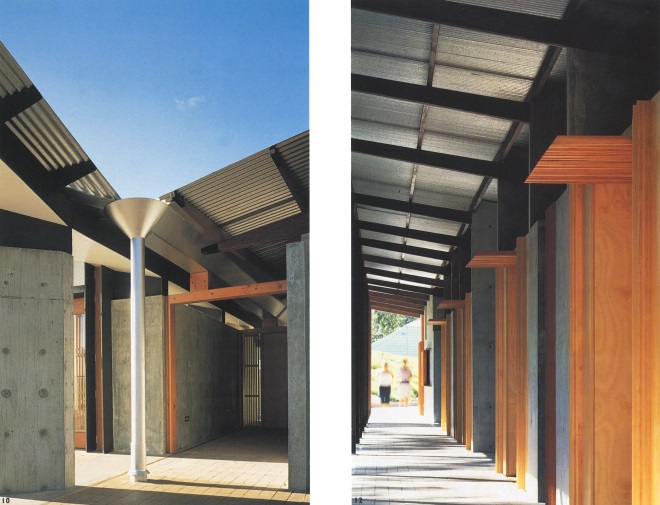
Left: Raw physical adds to the richness of surface texture.
Right: Walkway, protected from the climate, nonetheless still connecting with landscape.
References
1. Reg Lark was Murcutt's assistant for the Cleaved Hill Museum project (1987-1989, unbuilt) and the Done Firm (1991). Wendy Lewin became Murcutt'due south acquaintance five years ago. in connectedness with a project for the renovation of the Sydney Customs Firm (1993-1994, unbuilt), and for the pattern of the Opal M1ne Museum at Lightning Ridge (in progress).
ii. Most twenty years, if calculated from the kickoff phase of the museum (1979-1982), and over 10 years if calculated from the 2nd stage (1986-1988). Murcutt has been involved with very few other public projects and none has been built In October 1999, the Boyd Center won the Sir Zelman Cowen Award for Public Build1ngs -the RAIA's most prestigious federal honor.
iii. Boyd died on 24 April 1999, when building works on his Foundation had just been completed. Born in 1920, Boyd came from a famous family of Australian artists. He was a potter and a painter and divided his time between Australia and England. Murcutt, Lewin and Lark's customer was the institution in charge of managing Boyd's legacy to the State.
Source: https://www.architectural-review.com/essays/arthur-and-yvonne-boyd-education-centre-in-west-cambewarra-australia-by-glenn-murcutt
0 Response to "Riversdale Boyd House ââåarthur and Yvonne Boyd Art Centreã¢ââ"
Post a Comment